|
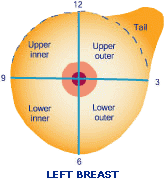
ANATOMY AND PHYSIOLOGY The female breast lies between the 2nd and the 6th ribs, between the edge of the sternum and midaxillary line. The nipple and the areola are exactly in the center but are somewhat lateral to the center of the breast. Sebaceous glands on the areola (glands of Montgomery) appear as small round elevations. STRUCTURE The breast is located in front of the chest, one on each side of the midline. The nipple lies just below the center of the breast. The skin surrounding the base of the nipple is darker than the complexion of the woman and is known as the areola. The glands situated in this region lubricate the nipple and areola during lactation and prevent them from cracking. For better description, the breast is divided into four quadrants by horizontal and vertical lines crossing at the nipple. In addition a tail of breast tissue frequently extends toward or into the armpit (axillary tail).
BREAST TISSUE HAS THREE PRINCIPAL COMPONENTS
Click here to see the components of Breast Tissue The proportions of these components vary with age, the general state of nutrition, pregnancy, and other factors. The male breast consists chiefly of a small nipple and areola. |