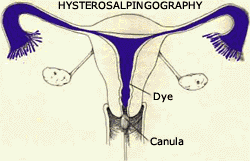
PATENCY OF THE TUBES HYSTEROSALPINGOGRAPHY (X-RAYS OF THE UTERUS AND TUBES) Once it has been confirmed that a woman is ovulating normally, next to be suspected are the fallopian tubes that transport the egg to the site of fertilization. The tubes may be blocked or restricted in their movement. Failure to conceive thus might be purely due to physical factors, even with normal ovulation. The most obvious case in point is the woman who has had undergone tubectomy. Many women, however, have blockage of the tubes because of previous infections, and most of the times these are infections they never knew they had. In India commonest is Tuberculosis. Even a simple case of appendicitis in young age can result in scarring around the area of the tubes, which could interfere with pickup of egg from the ovary. One of the easiest ways to determine the patency of tubes is through an x-ray called hysterosalpingogram, which is slightly painful. After pelvic examination, a liquid, which is opaque to x-rays, is injected through the cervix. An x-ray is taken and the doctor can see a beautiful outline of the cavity of the uterus as well as the tubes. If the tubes are open without obstruction, this liquid should spill freely into the abdominal cavity, and this is readily seen when the x-ray is taken. It is not sufficient simply to determine that the tubes are open. The fluid must spill freely into the abdominal cavity. The tube is a complicated structure, which must have complete freedom of movement in order to ensure that the properly prepared egg is not just wasted in the abdominal cavity.
|